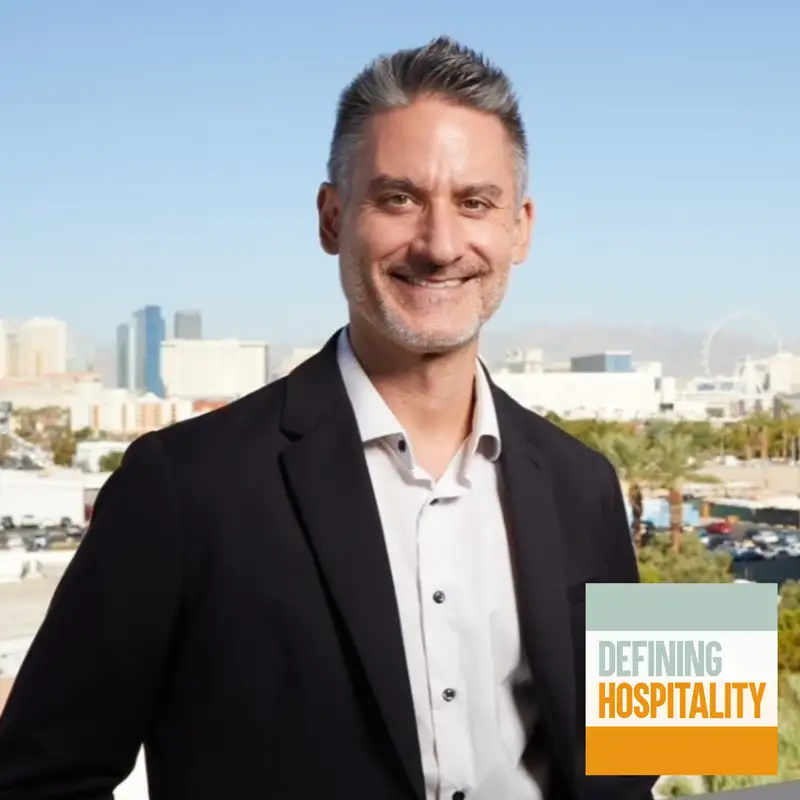
Hospitality’s Innovative Playground - Glenn Nowak - University of Nevada Las Vegas - Episode # 237
I'm always the first to tell my students I don't know everything there is to know.
Dan Ryan:What I do is inconsequential. Why I do what I do is I get to shorten people's journeys every day. What I love about our hospitality industry is that it's our mission to make people feel cared for while on their journeys. Together, we'll explore what hospitality means in the built environment, in business, and in our daily lives. I'm Dan Ryan, and this is defining hospitality.
Dan Ryan:This podcast is sponsored by BERMANFALK Hospitality Group, a design driven furniture manufacturer who specializes in custom case goods and seating for hotel guest rooms. Today's guest is an entrepreneur, licensed architect in Nevada, professor, creative strategist, and design expert. He is an accomplished architect and designer who has contributed to major large scale projects like the Flamingo in Las Vegas, M Resort, and Caesars, just to name a few. He's a prominent voice in architecture and hospitality academia with a focus on design research, innovation, and sustainability. He's an associate professor of architecture at University of Nevada, Las Vegas, UNLV, and cofounder of Arrow AI.
Dan Ryan:Ladies and gentlemen, please welcome Glenn Nowak. Welcome, Glenn.
Glenn Nowak:Good morning, Dan. Thanks for having me.
Dan Ryan:Oh, it's so great to see you, and happy New Year. And I would just like all the listeners to know that I'm a huge fan and supporter of radical innovation, and it it's a event that's put on every year in New York City. And with this event, there's a lot of submissions for really incredible, unencumbered, free flowing, pushing the envelope design ideas from products to projects. And associated with this, there's a lot of judges and advisers. And I met Glenn a couple years ago at this, but we really hit it off just talking at a cocktail party in the lead up to this year's this past year's event, and just had a really wonderful conversation.
Dan Ryan:And that's really why I love our industry and also going to so many of these incredible events that are out there. And I highly suggest whether it's radical innovation or other events, just get out there and have a have a conversation with a professor because it's not often I get to talk to professors. I love them, Glenn, and thank you for being here to share your view. And, yeah, thank you.
Glenn Nowak:It was great. And I feel like I learned a ton talking with you. You were so gracious in making some introductions to some other folks in the industry that turned me on to some new new concepts through research and white papers that they were doing. It it's a great way to share knowledge, and it it's been fun for me to be on that advisory board for Radical for many years now. I I enjoyed seeing them.
Glenn Nowak:It was quite a surprise going through one of the big expos here in Las Vegas and and seeing the the student design portion of that competition. There's a professional category and a student category. And as soon as I saw that, you know, I tried to figure out how to get UNLV involved, how to get our hospitality design concentration on the radar of students around the world that have identified that they have an interest in working in in the hospitality industry.
Dan Ryan:And that's one of the things I love so much about radical innovation as well. And also why I see you have your UNLV shirt on and you have the UNLV mug. But one of the things I love about radical innovation is especially with the students, right? Because they haven't been encumbered with building codes, physics, feasibilities yet, and they're really able to push the limits. So some of the professional like projects as well also are, like, pushing the limits of what's possible, and I and I love that.
Dan Ryan:But I also think you just being in Las Vegas Las Vegas is such a laboratory for and it's not fully unencumbered because there are still, like you still have to deal with gravity. You still have to deal with building codes and entitlements and budgets and all these other things, but it just seems to be on such an incredible scale. Every every property that I walk into in Vega in Vegas, I'm just always blown away. And to be able to have students studying design, it's like they're in the ultimate laboratory of pushing the limits and moonshots, continual moonshots. So I what how I'd like to weave that in is as it pertains to hospitality and all all that laboratory that Las Vegas brings, and also, I definitely see an overlap with why you're attracted to and continue to support radical innovation.
Dan Ryan:But what is like, how do you define hospitality? What does it mean to you, and what's keeping you pushing the limits of design within hospitality?
Glenn Nowak:Okay. So defining hospitality, I'm gonna give a long winded answer.
Dan Ryan:Great. You're a professor. You're allowed to.
Glenn Nowak:It has evolved really over over my I'm in my twentieth year of teaching, and I'm from the Midwest. I went to school out east. And through my entire upbringing, I loved music, theater, the performing arts, you know, all forms of entertainment. And and to me, that was the the component of hospitality that I was most attracted to. So moving out to the entertainment capital of the world was was initially, like, my my little piece of the hospitality world, the opportunity to work on some of those projects that you mentioned.
Glenn Nowak:But the the definition for me has expanded quite a bit over over the last two decades. I moved out to Las Vegas really expecting to see an embrace of hospitality design education. But at at the school, we we would only occasionally take a a a fleeting glance at what was happening just a mile or two from campus within our within our design program. And I saw there was a missed opportunity. You know, there there's huge projects going up all the time and remodels happening continuously year round every year.
Glenn Nowak:The Las Vegas is is reinventing itself. Like you said, it's it's a laboratory, living laboratory. And so about fifteen, sixteen years ago almost now, we started a hospitality design concentration in our graduate program, the master of architecture program at UNLV. And it took a lot of a lot of discussion, you know, creating new new program, new curriculum. And there were there were concerns.
Glenn Nowak:You know? There when when you're in Las Vegas and you say hospitality, it means to a lot of people, it means casino resorts, hotels, and casinos kind of that's it. That's hospitality. And that's a huge a huge driver. That's what what really drives our economy.
Glenn Nowak:But more and more, that that has changed. It's not just casinos that attract people to Las Vegas. It is these other forms of entertainment. And so I I heard from from professionals in in the community, from colleagues saying, well, let's do this hospitality concentration. It's about time.
Glenn Nowak:But, also, let's not become known as the casino design school, which which I can understand that casinos have and and likely will always have some stigma associated with them but it's also a a huge design opportunity understanding understanding how these things work.
Dan Ryan:Well, I I'm actually curious about, like, what would the stigma be? Because to me, and I'm not a designer nor do I play one on TV, but when you're working on a casino project, to envision the really, it's almost like an infinite form and all of the detail and the amount of people that walk through and then to create all these little moments and then also to disorient. There's just so much that you can play with. To me, it would just seem like and also, like, with the ultimate goal of make of driving revenue and profit for said casino, it just seems to me like that's the ultimate, like, tabula rasa or clear white white page or whiteboard that you can, like, really push the limits on. Like, it just seems like every designer's dream.
Glenn Nowak:Yeah. It you might think that, and I think a a handful of of architects in the industry would would agree. But you use the word disorient, and that is something that is associated with particularly casinos of the past. People recognize that they were sort of designed to if disorient isn't the right word to to confuse, to attract, to contain, you know, the idea of once you're in the casino, they want you to stay there and spend all your money.
Dan Ryan:Well, I I agree. Okay. So and that's super interesting to me too because, like, if you think about disorientation or ang like sometimes anxiety like, actually, maybe anxiety. Right? Anxiety, while it might feel bad at one point, on the on the immediate other side of that coin, it's excitement.
Dan Ryan:Right? And so that disorientation in the same way can also be like super exciting. Right? And so I don't know if and I I guess I see where you're coming from with the that idea of a stigma, but to me, to to really be able to push the envelope, it just seems like to be able to design for that is just and design is really about solving problems and and and finding alignment and finding the best path forward. It just seems like that's the the most incredible place that someone could work.
Glenn Nowak:And I wouldn't disagree with you. I think it is very exciting. That's part of what attracted me to Las Vegas. I see it as another component of the entertainment world. It it's these are exciting environments.
Glenn Nowak:But a lot of a lot of students in architecture, a lot of professionals in architecture might might tend to gravitate toward different forms of of architectural craft that going back to the term disorient, some might equate that with a kind of dishonesty in the form that that there's some it's a lot of thematic theatrics. I don't wanna say smoke and mirrors, but literally, you know, many casinos had been filled with smoke, and they had mirrored sids. So
Dan Ryan:But it's also in the it's also in the same way that, like, it like, this idea of disorientation actually is really fascinating to me because if you go to a large theme park as well, I think one of the things that they do so well aside from separating parents from their wallets very effectively, They just waiting in line, the never ending line, they disorient you while you're in line so you don't feel like you're in line. It it transports you. It keeps you occupied. And to me, that I think because people are always changing. And if you if you look at the cross section of people that go through a casino floor, it's every kind of person you could ever imagine.
Dan Ryan:So somehow, whatever that disorientation or that excitement or that that experience is, it's it's on such a large scale, but it's like laser focused on delighting in some way the passerby.
Glenn Nowak:Yeah. Absolutely. And I think because you can look anywhere, practically anywhere on the strip and see, you know, very, very different groups of people attracted to very diverse sets of environments and being thoroughly entertained by them. That's that's what attracted me to, excuse me, to see this as a learning opportunity. That the the proof was in the the attendance that you mentioned the idea of generating revenue through these elaborate environments.
Glenn Nowak:And, again, I I think that has been a a missing component in a lot of architectural schools' teachings that while there are some that may focus on on the business of architecture, more often than not, at least in my experience, you know, I I was I was trained as an architect, and I understand how buildings go together. I understand how we would analyze the site. I understand. But I would I would critique my own formal education as as not spending nearly enough time understanding how architectural decisions translate into revenue.
Dan Ryan:It's the business case of architecture. Right? In many cases, the business case for an office building is like, how do you maximize your rents, right? It's pretty simple. Although nothing is simple, I don't want to discourage or disgruntle any office building designers.
Dan Ryan:But when you think of hotels and casinos and especially large format with all the experiences and shows and everything that Vegas there is there's so much throughput and revenue opportunity in them and to design for that must be really exciting. And if you think about I know you said you came from the Midwest, but you must get applications for people to come to your architecture school from all over the country and world, I would bet. And then what is the type of student that thrives? Like, if you were if you were like the the Harry Potter selection hat. Right?
Dan Ryan:And it goes around, what would what would make what attracts that student? What what's that ideal student that would come under the umbrella of Las Vegas and and learn how to push the envelope at UNLV?
Glenn Nowak:Great question. No one answer for sure. We do attract students from around the world, and they come from across the country as well. I think so this may help me continue my definition of hospitality for the for the earlier question because so students that come from far away, not not Las Vegas locals, are very different than those students that grew up here. We we attract a lot of our our graduate students come through the Clark County School District or or other schools in Southern Nevada.
Glenn Nowak:They'll they'll go through our undergraduate program and decide to stay here. For them, The Strip is is familiar. They grew up with it. For somebody across the country or around the world, they're seeing The Strip with new eyes. It is it's like a dreamscape for them.
Glenn Nowak:And both of those student backgrounds kind of coming together result in very different outcomes through the through the program. So some of some students, they they may understand, boy, Las Vegas has a lot to teach. Reminds me of the book Learning from Las Vegas. You can always learn from Las Vegas whether you're whether you're about to design an integrated resort or you're interested in other archetypes. So within the hospitality concentration and my definition of hospitality design is it's not just casinos and hotels.
Glenn Nowak:It's it's as you know from from your time in the industry and all the other guests you've you've had on this show, it's it's restaurants. It's meeting space. All of these things that come together in these extremely complex integrated resorts, each one of them is is their own little microcosm of hospitality. It gets even bigger, though, because those those students that look at the integrated resort or Las Vegas' version of hospitality at large, they might go, you know, I I really I'm passionate about schools or office spaces or residential design. And the hospitality definition that that we've we've begun to share with more and more students is you can be you you can have hospitality in these, quote, unquote, nonhospitality archetypes.
Glenn Nowak:There's no reason why we can't be as engaging toward students in a classroom as the example you shared of people waiting in line for a ride in an amusement park. There's there's equivalence to revenue that you're generating. If you're if you're generating attention and focus in a school and and making learning a fun endeavor, you're making a really positive impact using principles of hospitality design in schools. You can apply principles of hospitality in the workplace, in in homes. And so it it kind of has a ripple effect.
Glenn Nowak:You can learn from Las Vegas and apply those lessons outside of our traditional, notions of of hospitality design.
Dan Ryan:I understand the discomfort with that the word of disorientation, but I'm gonna go disorientation, excitement, basically, this emotional movement. Right? So there's a hotel or a building that that functions. Right? There's a functionality to it.
Dan Ryan:Right? The structure facilitates the function. But how in Vegas in particular, I think, okay, there's always the functionality for all those different programmatic areas of the footprint of a building or a residential community or you name it. But how do you I how do you from a design perspective as a as a teacher, how do you bridge that gap of, okay, it functions, but how do we get this to be, like, super dramatic that will move you? Right?
Dan Ryan:That to me, that emotional highlight is just a very difficult thing to teach, especially when you're coming if especially if you're it's like a graduate degree, you already have, like, some kind of example of how the world works and how things are built. Going to Vegas, just structurally, just the the scale is just insane. So how how do you get people to learn about that just materiality and just the spans and just all of the the materials to to get it to where people have these incredibly positive or maybe even negative experiences, but it's all an emotional explosion.
Glenn Nowak:There isn't a a formula on how to teach this for sure. Each each project is very different. I'm always the first to tell my students I don't know everything there is to know about integrated resorts. I've I've worked on the design of of several of them. I visit them as often as my schedule allows, learning learning how new new projects are coming together.
Glenn Nowak:But I would I would say you'd you don't try to teach it as if it's a formula because it if if it becomes formulaic, it can't produce the same effect because you anticipate it. You know? You'd you'd become numb to it. And so from the earlier years of the hospitality, we call it the HD HD concentration, h the HD studio in the in the grad program. I didn't try to teach students how to do any of it.
Glenn Nowak:Instead, I would ask them to critique it. Do you take a look at what has been built either here in Las Vegas or we would look at hospitality projects in cities around the world. Fantastic projects by by all measures, but then ask them, well, how would you make it better? Asking questions and and back to your question of how do you how do you get students to marry that functional aspect with the the emotional side of things. There's a lot of experimentation that we get to do in a design studio.
Glenn Nowak:There there isn't, you know, a right answer for for the sort of projects and and problems that we assigned. Instead, students would would develop, you know, their their hypothesis of what would make this better. Let me let me show you what I think would would create the sort of, response from from a prospective guest. And our design reviews then are are made up of, other professionals in the hospitality industry. It might be architects.
Glenn Nowak:It might be hotel executives. It might be other faculty. We reach across to other disciplines in the university, and and and we we gauge many different iterations of these design. I would I don't wanna call it a solution or a design proposal to to better understand, well, how can you how could you change the proportions of this, the colors here?
Dan Ryan:But I guess I guess where I'm trying to go is, like, if I look if I were to look at the world and look at Las Vegas, I would put it in the same neighborhood as, like, Abu Dhabi, Dubai, pick a large city with like architectural innovation in China somewhere that's really pushing pushing the limit. Right? A lot of the innovation that comes from doing these large format, like, hard to get your head around projects. There's a lot of innovation that comes through structurally, materially. What's a heat what whether in Vegas or somewhere else, is there from an architectural perspective, what's one of the biggest, maybe most more under discussed innovations that you've seen to make one of these buildings come to life?
Glenn Nowak:Technologically, the the nuts and bolts of architecture, We can figure out how to design anything. The the challenge is getting acceptance for a project, getting getting community buy in, all all of the stakeholders and politicians, etcetera, to to say, let's move forward with this project. I I think something like the sphere is a good example. Like twenty years ago, if you would have said, you know, we're gonna build a giant immersive performing arts venue, you could stick the Statue Of Liberty inside of it and see, you know, digital displays 300 to 60 degrees. We we might think you're crazy.
Glenn Nowak:But when you and and really, if you were to pro propose something like that in any other city in the world, which I understand they they proposed it in in multiple areas with some pushback. Las Vegas, back to our our idea of calling this a living laboratory, there were enough folks here that said, bring it. You know? And so you you pull design professionals that could pull that off.
Dan Ryan:And, also, I think just how they innovated that from the sonic direction out, I don't even know the words for it, but, like, how they can point the sound different places, the three d or no. The fully ink like, the I don't even know. Like, the big LCD or LED screens on the inside and the outside. I bet you that just how does that even survive outside in Las Vegas? I think there's gonna be some innovations from that that are gonna apply to places that we can't even imagine.
Dan Ryan:Selfishly, I I haven't seen a show there yet. I've been trying to go see fish, but the tickets always just get too darn expensive. But selfishly, I'm so grateful for this fear because it took MSG and James Dolan's focus to get that thing open, and then he wasn't meddling in the Knicks very much. So the Knicks became very good over the past couple years, and I'm I'm chalking that up to his attention on the sphere. But Win win.
Dan Ryan:I think that that's an incredible example of how that that also is just, like, transformative to the skyline as well and tells a whole other story.
Glenn Nowak:Yeah. And I like to think, you know, if you rewind the clock and look back at other smaller innovations along the strip, many of these things sort of lead up to the kinds of innovations that we see in the sphere. Thirty years ago, the the Luxor, this giant pyramid, world's largest indoor atrium, and the the bright light on top has has some similarities, the iconic form, the unusual, building type or or, the the structure used to to create that. And then marquee signs up and down the strip have gotten so much more sophisticated in the last fifteen to twenty years. They used to be, you know, just the flashing neon and then the the addition of LEDs, the merger of moving parts with LEDs, and and continuously bigger and bigger.
Glenn Nowak:You know? There was a Yeah. Five to ten year span of towers going up hotel towers, each one outdoing the previous in height by a couple couple inches or a couple stories. And, just the architectural, portfolio of Vegas sort of showing how you make incremental progress and and then every once in a while, huge innovations like like the Sphere.
Dan Ryan:Hey, everybody. We've been doing this podcast for over three years now, and one of the themes that consistently comes up is sustainability. And I'm just really proud to announce that our sponsor, BERMANFALK Falk Hospitality Group, is the first within our hospitality industry to switch to sustainable and recyclable packaging, eliminating the use of Styrofoam. Please check out their impact page in the show notes for more info. From the students that are attracted to UNLV and to your program, there's an there's a whole spectrum.
Dan Ryan:There's a gamut. There's not one typology of student that would come and excel there. It's everyone. But can you share an example of someone that started working there? You don't have to name names, so just and maybe you can combine a couple different people, but I'm always intrigued by someone who grew up in the Midwest and maybe hadn't traveled a lot or someone from somewhere else anywhere in the world that hasn't seen that strip and the buildings within the strip and that laboratory that's at your doorstep.
Dan Ryan:Right? What is it are you ever with any students when it's, like, the first time they're experiencing this large scale craziness that the that Las Vegas offers from an architectural perspective?
Glenn Nowak:Shock seems to be kind of a common, common experience. The the challenge of wrapping their head around the scale of things, and you hear that even from from, tourists within The US. Like, you can see one of the resorts a couple doors down, and if you think, oh, it'll only take a minute or two to walk next door. And
Dan Ryan:Thirty minutes later, you're still letting.
Glenn Nowak:But they come probably anticipating a little bit of that, but to see it to to to see how, thorough a lot of the the design is. The it's not just big. It's not just bright and flashy from the outside. But when you when you begin to walk through, and not just the casino, but the the shops, the theater spaces, you start to really appreciate that, boy, every square inch of this entire facility and millions of square feet have been have been carefully considered. And that allows them to sort of dream that big and bigger.
Glenn Nowak:So the the idea back to Dolan's sphere started as a napkin sketch. Right? Like, and that was enough to get the ball rolling and and to turn it into a reality. And when students that have never seen or maybe they have seen it, but when when you have the opportunity to tackle a HD studio project or propose something of your own, you're the bar has been raised for sure when you're here in Las Vegas. And so the students' version of a napkin sketch is is kind of the equivalent.
Glenn Nowak:They're not as encumbered by budget and and building inspection approvals because we're we're still designing fictional projects. But with a level of realism because we want we want to push them. We we understand that the students that are graduating from from the program are going to be going into the firms that are actually tapped to do these projects. So many of the the integrated resorts around the world have involvement by the local architects here in Las Vegas. Like, this is such a unique archetype.
Glenn Nowak:There aren't that many that have the the expertise or the experience.
Dan Ryan:Can imagine I can imagine. Like, when I think about the the the play land that Vegas must be for an architect or a designer or an engineer, to me, the next unencumbered place to play, like, where you could really push it is probably video game design. Right? Because I'm sure I don't know this. I'm just going out on a limb.
Dan Ryan:I'm sure a lot of video game designers or companies have architects that work with them, and they they don't have to deal with gravity and structures and everything. But but you get the feeling that these things might work in real in the real world. And I would also think that we're talking a lot about the finished product. I bet as a student in UNLV or at UNLV, I'm do you I'm sure you guys must go to job sites as they're building these crazy structures and to see how the engineers and how the general contractors and sequence everything and put everything together. Do your students get to put on hard hats and walk job sites?
Dan Ryan:And what is it like when they see that?
Glenn Nowak:I'm the architect licensing advisor at our school and and for the state of Nevada. And one of the things I do outside of class assignments is organize hard hat tours. So we took a group of about 40 students, one of the few one of the few granted access to to the sphere when it was under construction. But over the years, we because it's an educational focus, we're able to see a lot of the projects going up on the strip, understand how they're being put together. And for students, that's that's one of the most amazing experiences because we're we're able to see, yeah, the the construction documents.
Glenn Nowak:They'll either unroll them or now it's all on digital screens and tablets and see how the drawings are being translated into the actual object in the in the field.
Dan Ryan:Some architectural students, I'm sure, are wanna focus on the design and building the structure, but I'm sure some people that some students that maybe go through your program, they're there, and then when they see the things being built, they're like, oh, wow. I, like, I love the idea of coming up with that sketch on the napkin as a designer, but also I'm really intrigued by how this large scale, huge forms get put together. And like, how do you communicate these bent steel columns and and and beams to, like, come together in the form of a sphere or whatever it is at the end. Or even using the sphere again, I just can't imagine how all that is it LED? Is it LED or LCD?
Glenn Nowak:LED. What it is.
Dan Ryan:LED? I don't know how just on the exterior, the LED, the the sphere, there's space between the structure and the LED screen, and then there's expansion and contraction because I assume vagus must get the the surface of that stuff must get over
Glenn Nowak:Very hot.
Dan Ryan:Like approach boiling or hotter to super cold. And then I'm sure, like, critters and things get in there and and so they must be learning how these things function and build as they're building it if they've never built it before. And there's such a, again, going back to that idea of what draws you to radical innovation in New York, there's so much radical innovation in just putting these damn things together in Las Vegas that just changes the way things are built.
Glenn Nowak:When you when you see these projects under construction, now one of the biggest, on the Strip is the giant guitar tower, part of the the hard rock rebrand of Mirage. The Mirage was it's really recognized as the first integrated resort. It had all of the the the theater, the shops, the the casino, thousands of rooms, hotel. But now, they they're building, similar to what Hard Rock did in Florida, but at a scale even even bigger. When students see these kinds of projects up close, they begin to understand the the complexity of the architecture is is a reflection of the complexity and diversity of the teams involved.
Glenn Nowak:So Mhmm. Yeah. The architects play a major and and leading role. But your example of, you know, how to bend the steel or the the purchasing, like, all of these come all these elements of the the construction process tie their architectural education into so many other disciplines across the the entire university in my in my world or the entire, the entire population in terms of just outside of campus life.
Dan Ryan:And the global supply chain.
Glenn Nowak:Yeah. It's like
Dan Ryan:these ideas that start on a a napkin and have never been done before, like, do you do it? And I love that you said the purchasing side because somehow you have to take that napkin, turn it into a full drawing, then actually find, I assume those LEDs were made in Korea, find this Korean
Glenn Nowak:Yeah.
Dan Ryan:Were they? I'm just going out on a limb there. Go.
Glenn Nowak:Okay.
Dan Ryan:Find like, how did we make that one thing in Korea and have it attached? It's just so incredible. And then also as UNLV and being a state school, you must have opportunity just not just in Las Vegas, but beyond Vegas to just have an impact on how the state is dealing with all the land that's around you as well from, like, a social, economic, sustainable, and design perspective. Right? You're you guys are must get brought into so many cool projects throughout Nevada.
Dan Ryan:Is that true?
Glenn Nowak:Yeah. We we have all kinds of opportunities. You just gotta constantly be open open to those. I mean, that the the purchasing discussion reminds me of a a visit we had toward the beginning of the year right after the announcement of tariffs and we had students asking these brilliant questions about, well, how how does that impact the the steel on this project? And, you know, the the foreman was able to tell us all that that steel has been here for a month already.
Glenn Nowak:It's not affected. It's probably because everything was being shipped mostly unaffected for the entire project, but the next project. But, like, stick
Dan Ryan:No. No. The tariffs are gonna bring the prices down for everything.
Glenn Nowak:Will some Will see. The the idea of, just impacting, architecture across the state, I mean, that that reminds me of, again, previous question and and thinking beyond the strip. Like, some students think about about opportunities that are that are not just nestled in our tourist corridor. We have one of the the past radical innovation winners, this was maybe eight years ago, nine years ago, had proposed some kind of space tourism and was designing hotel rooms that would orbit Earth. You know, taking taking what is what at the time was completely science fiction and showing how it really could be a conceivable thing.
Glenn Nowak:And and just in the last year, we've seen developers proposing real real world space tourism launch sites out in the Desert Of Nevada. Whether or not they come to fruition, it it's really becoming that much closer. From Las Vegas, I can I can see, you know, when rockets are launched out of California? It's and that's that's maybe where one future of of hospitality is going.
Dan Ryan:That's a future one. I'm glad it's happening, but I have no desire to sleep in this space. I like I like what we got going on here. But I'm glad that we're pushing it because other people should like that. Like, I don't wanna be the first person sailing across the ocean thinking that the world might be flat, but I'm glad people did that before us because, again, it's that idea of innovation and always pushing.
Dan Ryan:And I just think that Las Vegas offers that opportunity for those call them design cowboys and girls to come and, like, really push the envelope and continue to innovate. You were mentioning also I know in the in the intro that you also founded an company. Tell us a little bit about that as well.
Glenn Nowak:So the the company, Arrow AI, is a technology startup. We've been now in in business for just over three years. And I I would say in large part, thanks to this growing entrepreneurial design or or business development push from the university to see more more innovations that create an economic driver for for the state. It inspired me, and a couple former students to to just think about some of the work that was happening in in our design discussions and look for ways to fit that into into the industry. So what what is normally very fiction based, you know, when we're when we're doing our napkin sketches, as far as a a project goes, is a pin up on the wall typically in architecture school, or a little physical model that you can hold and turn around.
Glenn Nowak:And my student had designed a proposal for a a VertiPort, a like an airport, but for drones. And to integrate those, like, one more thing, like, to for an integrated resort. They have they have everything. There is there are restaurants, the meeting space. But it would be hard to consider them transportation hubs, although their their transportation infrastructure is pretty pretty robust.
Glenn Nowak:None of them besides, maybe a couple helipads here and there, for emergency uses only, would have a VertiPort. And
Dan Ryan:that in And is that for drones for product or
Glenn Nowak:for people? Both. You could you could imagine being able to, you know, order up room service from another property and and have something or or go shopping and have your your suit or dress delivered directly from across town. So that was the fictional thing, and and there are businesses out there now that that do that. It's super fascinating.
Glenn Nowak:But because I'm architecture design process oriented, we we looked at taking drones and scanning scanning vacant sites, projects under construction, completed works. So equipping drones with three d scanners, lidar, No way. More than that, developing ways to take the three d models that we could generate and make them highly interactive. So it it's it's always fun when you're working in Revit or SketchUp to to kind of pan through or create your your own animation to better understand this this digital model that you've created. It's difficult to turn those tools over to nonarchitects if you're not familiar with how to use the software.
Glenn Nowak:But taking even a Revit model or a scan from a drone of a real project that we can merge these two things together. And then the platform that we've developed at Arrow AI makes it so intuitive that you can navigate through these these environments as if you're playing a video game using a game engine technology, walk around with your avatar, walk through buildings, and and the fact that we can merge the digital model in a scanned replica of a site, you can you can really begin to experience, like, what is the exact view I have from this particular room, or, what's my experience walking in from the street or driving, from fill in the blank. So it's it's a way to share the anticipated experience or different versions of the proposed experience that is frankly, it it is kind of unmatched. We've we've assembled such a a rock star team. My cofounders, Victory, Ibn O'Arro, and Richard Bergstrom.
Glenn Nowak:The team has grown quite a bit in the last few years, and and we're doing a lot of scans that kind of simplify the way we can interact with these extremely complex sites and, often more complex buildings, integrated resorts especially, but really any any hotel. We don't we don't limit ourselves to just the hospitality industry, but because of our networks, that's where a lot of our work has been focused. And earlier when you mentioned something about video game design, I I thought that would have been a good time for me to to mention this because we not only are we making the interaction with these these virtual spaces more accessible like you are playing a video game. But the AI component of of our company Aero AI is we are really leveraging artificial intelligence and and dropping AI bots into these models that we create to help guide guests. So we can have multiple people taking a visit to our virtual site, and it it can be a tour.
Glenn Nowak:It it can be a q and a session. We we would train the AI bots on everything about the forthcoming project. We've we've seen just so many overlaps in opportunities. Like, ten, fifteen years ago, I was involved, maybe not even that long ago, nine or ten years ago, involved in in a master planning project. It was a funded research project through UNLV and our downtown design center working on a master plan for the historic Westside neighborhood in Las Vegas.
Glenn Nowak:And what was produced was pretty pretty great work. A lot of community involvement, a lot of expertise from the university and the the profession. And the outcome was a was a robust report, a 100 plus pages, static drawings, kind of what what you get in in a lot of master planning exercises or community design charrettes, a report at at the outcome. And fast forward to today, that report still, you know, it it sits on plenty of shelves or in the the files of somebody's computer and only a little bit of momentum has been developed in in actually seeing some of those plans come to fruition. What what we hope to do is is leverage these newer technologies that, create interactive virtual models and invite not just community members or other stakeholders into a project in a in an early planning phase, and then we write it all down, and then we bind it and call it done, where we all have to get together in a same room or on one Zoom call.
Glenn Nowak:But
Dan Ryan:So in essence, they can just, like,
Glenn Nowak:plug in. They can drop in. They can, they can visit virtually anytime. They can leave their comments, and, people can meet in the virtual space. And these spaces, when we scan a vacant site, we can toggle with a button, you know, different proposals for that site so that people can see.
Glenn Nowak:Like, this is what this is what this developer is proposing or this is what we can produce with this kind of budget versus this kind of budget. Or if we can look at yeah. All sorts of variables can be built in and collect feedback. It it kinda comes back to that that notion we talked about earlier of just experimentation in the design studio. Now you're you're able to really share these experiments that really could and should happen in the real world.
Glenn Nowak:Let's let's see what we can build. Let's let's try to better anticipate what the the benefits and the reactions amongst the community might be.
Dan Ryan:I'm I'm gonna go out of a limb on a limb here, Glenn, and say, from what attracted you when did you start at UNLV?
Glenn Nowak:2006.
Dan Ryan:Okay. 2006. So you have your UNLV. You're in this exciting lab of innovation of Las Vegas. Eight years ago, plus or minus, you're attracted to radical innovation, working with companies and students from all over the world to continue to push innovation in design and in hospitality.
Dan Ryan:And then by meeting these other students and other partners creating this innovation, innovative company called Arrow AI. If you imagine a a Venn diagram of those three things, right, innovation in all of them, but they do overlap. Take that Venn diagram and tell excites
Glenn Nowak:you most about where you sit into the future. Yeah. Really to to see that Venn Venn diagram diagram replicated over and over. There every year, there are students that come from all over the world both to radical. You know, they're submitting to radical innovations design competition, and they're applying to to graduate school, whether it's here at UNLV or anywhere.
Glenn Nowak:But to to see that, okay, they're the next generation is coming up with these really cool ideas. How do we support those ideas to address the the critical real world thing. The challenge that's making them not real yet, but just a a couple things to work through so that they become the next wow experience that we all get to go see.
Dan Ryan:It's almost like if you take that Venn diagram and replicate it over and over For the students that are coming into you and to to to touch all parts of this Venn diagram, it's almost as if you're giving them the experience and the tools and the mindset to turn that napkin sketch into whatever the next fear is or into the whatever that next thing is. You're arming them to be able to adapt and innovate.
Glenn Nowak:Yeah. Yeah. My critique of some of my own experiences in academia when I was a student and and even early teaching was we had so many great ideas that at the end of the semester, you do. You pin them up on the wall. You have your model.
Glenn Nowak:You get some feedback, and then you roll it up and and it goes away. For for the last ten, fifteen years, I've been pushing for the students to think, how do I how do I continue this beyond my graduation happening in a few more months? Because otherwise, you you know, you go to work, you start doing the nine to five, you're working on something where you're being told this is what we gotta do versus driving the the change or critiquing, asking how things could be so much better. And I get the students to to just brainstorm like, alright. If if this were to be its own business, what what would that be?
Glenn Nowak:If is there something in this project that I could patent? Is there something that I ought to publish? Is is there a a community partnership? Like, how do I reach out and connect the dots between this this thing that was a napkin sketch, now it's a really fancy rendering and and a detailed, set of drawings? Who really needs to to see it?
Glenn Nowak:How do I make it become that much closer to reality?
Dan Ryan:So as as I think about as I'm hearing you say that, I'm going back to the Venn diagram and, like, in that middle part of where where they all converge. If I were I love these magic wand questions. But if I were to give you a magic wand and you could do your dream project, no zoning, no budget, no RFP based on being in the middle of that, those three intersections, what would it be?
Glenn Nowak:Dream project. We have a bit of a a dream project opportunity. It it's still very far off on the horizon, but a 2,000 acre North Campus is being discussed at UNLV. It's currently I think current still federal land that's in the process of being transferred to the university. 2,000 acres is is massive.
Glenn Nowak:We we have a campus of over 30,000 students and the main campus is right now 300 and I think 90 acres. So 2,000 is is huge and it's barren desert. And our HD seminar was asked, just over a year ago to to just brainstorm, treat it as a a tabula rasa. What could happen? And and the magic wand question makes me think, obviously, anything could happen from, I mean, we were talking about space tourism twenty minutes ago to you know, we've got, the Tesla tunnels running through our city now.
Glenn Nowak:Like, anything you could dream, the sphere, anything you could dream could become a reality given the right the right conditions.
Dan Ryan:Oh, I
Glenn Nowak:love it.
Dan Ryan:So when do you think that when do you think it'll take the next steps going forward?
Glenn Nowak:I think there's some remediation that that has to happen on that land, But I think it's it's such a huge plot that portions of it could could possibly start to see some development in the next four or five years. But this would be probably a decades long endeavor. And, this also kinda brings me back to the definitions of hospitality. It's it this this site is not like our current campus. Our many campuses, you you can tell when when you've arrived at campus.
Glenn Nowak:It's different than a lot of the the surroundings. This portion of the desert, has the ability to kind of reach out and touch on so many communities around the Las Vegas Valley. A lot of people don't even realize Las Vegas. The strip is not part of the the city of Las Vegas. It's in paradise, the unincorporated township.
Glenn Nowak:Clark County has city of Las Vegas, North Las Vegas, Henderson. And I think a a future vision, the magic wand version of of a North Campus would be open to connections with all of these different stakeholders in our broader community. So hospitality is just an openness to others. That that's almost verbatim a quote of Jacques Derrida's definition of hospitality. Radical openness to others is is what he said.
Glenn Nowak:And I think I
Dan Ryan:think a
Glenn Nowak:project that has students thinking about, well, how does this not just make a a hotel guest feel great, or how how does this generate the most revenue from this this casino player? But how can this be a space that is hospitable toward fill in the blank. I really just wanna dream really big. Like
Dan Ryan:I love it. People I have an I I think that that would be a really cool tabula rasa for contestants in radical innovation to play with. Right? Like, what could that be? Because, again, that you just said radical again.
Dan Ryan:Having that well mapped, clean space in North Las Vegas of 2,000 acres, that could be a fun playground. And I don't know. That's that's really exciting. I actually I gotta wrap this up right now, but I wanna say, Glenn, this has been such a wonderful exploration with you, and I'm so happy that you're involved and passionate about radical innovation and all the work that you've done to create this Venn diagram and trying to be in the middle of the intersections as much as possible. I just wanna say thank you for for your time and experience.
Glenn Nowak:Thank you. This has been a lot of fun, and I'm looking forward to another great semester at UNLV and hope to attract more students to participate in that radical hospitality design competition. And, yeah, let's keep in touch. This is this is fun.
Dan Ryan:Awesome. And thank you to all of our listeners because without you, I wouldn't be at Radical Innovation. I wouldn't be bumping into Glenn and having these awesome conversations and being able to share them with you and to better understand the laboratory that Las Vegas is. So thank you all very much. We'll catch you next time.
Dan Ryan:Don't forget to like and subscribe, and thank you.